The Caspian Riviera

From Uzbekistan the Caspian Sea lay between us and our route back to Europe. We could either drive around it or take a 30 hour ferry across it. Driving around it would mean getting a Russian transit visit and driving through Chechnya and the Southern Caucuses. The ferry we had heard could involve a lot of waiting, bureaucracy and was a bit of an old rust bucket. After doing a bit of research we decided to go for the adventure of a cruise across the Caspian. We had had enough of going for visas and had heard that the ferry had become much easier. Our adventure was to start though well before we even boarded the ferry.
From Nukus it was a thousand kilometres across the Uzbek and Kazak desert to Aktau, the port where the ferry left, with not a lot in between. We had met Michael and Cate at various stops as we traveled across Uzbekistan and they were going the same way. Michael had been riding a motor bike but the engine had given up and he had left it in Kazakhstan. Cate was still going strong on hers. As they were going the same way we decided to team up. Michael needed a lift and Cate’s bike only had a seven litre tank. Petrol was scarce in Uzbekistan (diesel even scarcer) and there was not available for large parts of the desert crossing so we would carry a jerry can of petrol and refuel her along the way.
As it was still very hot in Nukus, Cate left very early. We had the benefit of air conditioning in the cab so left at a much more civilised time after breakfast. Later that afternoon we met Cate as a small cafe on the dusty windswept desert steppe. She had been there a few hours waiting with the truck drivers and it looked like the sort of place that a few minutes was way too long.
We decided to push on so that we could camp just short of the border with Kazakhstan which we were planning to cross the next day. “You go first” Cate said “I will be faster and catch you up.” We had agreed that we would stop after 100kms to then travel together. So off we set. The scenery was flat and monotonous and whilst the road was quite good there were some bad pot holed sections. We happily drove the 100kms but Cate hadn’t passed us. Maybe the wind had slowed her down? After half an hour waiting we decided she couldn’t be that slow and turned around. After heading back 50kms we saw Cate. She was riding slowly but thankfully alright. The problem was her clutch was slipping. She had tried to adjust it but it was still slipping. What to do? It was 400kms back to Nukus. She decided she would ride slowly on and we would follow her.
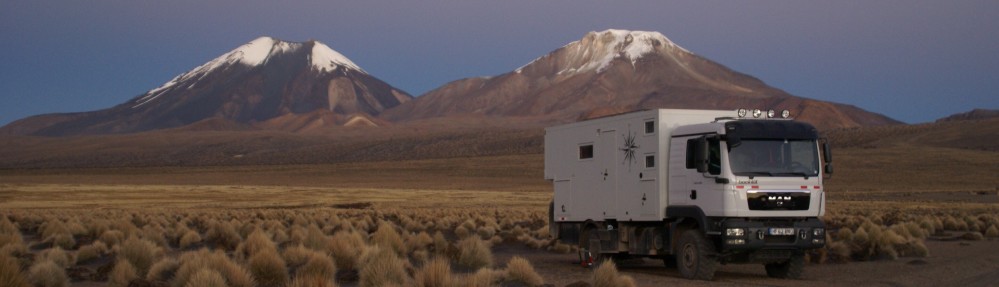
We set up camp that night in the desert. It was nice to be back wild camping after the ancient cities of Uzbekistan. The wind brought the temperature down and we were treated to a magnificent sunset.


The next morning was a short drive/ride to the border. We were a bit early and it hadn’t opened so had to queue. Fortunately tourists were given preference and at every step of the process we were told to go to the front of the queue. Exiting Uzbekistan was easy and Kazakhstan was also going well until it came to doing the temporary import for the truck. First I was sent to the commercial trucking desk. I tried to explain I was not a goods vehicle but initially to no avail. I was told to fill some forms in which made no sense so I kept protesting. Eventually surrounded by customs officers and after a few phone calls they agreed I should be treated the same as a car so I was sent to the car importing desk. Here the man first wanted to see the vehicle, on seeing it he said no you are not a car you are a truck and sent me back to where I had been before. Further calls ensued and yes I was a car. The only problem was the car processing guy still refused to process me despite been instructed to do so. One of the customs officers explained he was the longest serving member of the customs post and wouldn’t listen to anyone. Don’t worry he said it will all be sorted shortly. More calls were made and eventually the head of the customs office came over. Five minutes later I was back in front of the car processing desk. The man was now all friendly and happily processing my documents. It had taken over an hour of discussion but we were glad to be on our way.


On entering Kazakhstan the road took a turn for the worse. It was 80kms to the small town of Beynau and that stretch of road was rough and badly potholed. About half way along we heard a big rattling in our front wheel. We knew what this was. The front disc brake cover had broken off yet again. Note to MAN: you need to redesign these as they really should last more than 10 to 20 thousand kilometres. Pulling to the side of the road we had to remove the front wheel and replace the cover with an old one we had had welded in Tajikistan.  


The bad luck didn’t stop there though. As Cate rode back to meet us she went over a nail and got a puncture in her back tyre. Not having the tyre levers it meant we would need to get it fixed in Beyneu. We took off her wheel but we could not carry her bike on the truck so we left her there on the side of the road in the middle of the desert. At least it was cooler. The plan was Michael would get the tyre fixed in town while we did some other jobs. Cate would try and get a lift into town from another vehicle that could take the bike and if all else failed we would drive back out into the desert with the repaired wheel.
Fortunately Cate managed to get a lift and the tyre was quickly fixed so we all met up in Beyneu. Not wanting to spend the night there we drove out into the desert again. It was easy to pull off and drive away from the road. It was a lovely setting for the evening and again we had a magnificent sunset.


There was only 400kms now to Aktau on mostly good roads with only the occasional rough section. After hitting one of these rough sections we heard a hissing coming from one of our rear tyres. We had a puncture and the tyre was going down fast. We were on a steep hill so I slowly guided the truck down to a level section where we could change the tyre. Having Michael and Cate was a big help as we managed to change the wheel in less than an hour. We hoped this was the end of the run of bad luck. At least Cate’s clutch was holding up.


As we approached Aktau the landscape became less impressive. Aktau is an oil town and we started seeing nodding donkeys and an industrial landscape. We decided to head straight to the port, as who knows we could be in luck and a ferry could be leaving that day. They don’t run to any schedule so you can’t plan in advance we were told they just go when they go. If you ask when it is going they say shortly after it arrives.
Arriving at the ferry office we quickly found the “ticket” office. There was no ferry that day and the next one was in two or maybe three days. Fortunately we could register the vehicles on the ferry list but they would call us closer to the time for us to go back to do all the formalities and to buy the passenger tickets.
With a few days to kill and Aktau not looking that attractive a prospect we found a nice little resort hotel on the edge of the Caspian Sea. Looking one way there was a pleasant sandy beach, looking the other way we were right next to the port! The Caspian Riviera. The most important feature though was it had a lovely pool which Alisha and Lucy had been fantasising about since the heat of Uzbekistan.  


It meant we could spend a relaxing few days. On the second night it was Michael’s birthday and he took us all out to a lovely restaurant for a local meal. The only challenge was deciphering the menu with my appalling Russian.


At the end of the second full day we received a call, we had to go to the port immediately. We thought this was just to buy tickets but it was also to do the procedures for the vehicles to get on the ferry. The process was not straight forward and a combination of my bad Russian, unhelpful officials and no one understanding the process it took a while. There were a number of other travellers taking the ferry too. A couple of other motorbikes and some foot passengers so we eventually worked it out and started to amass a large collection of stamps on our forms. 
I had left Gilly and the girls at the hotel as we knew the ferry would not be leaving until the next day so I was a bit concerned when I was told to take the truck into the port and I couldn’t come back out. Eventually I ascertained that the ferry was not due to arrive until 11 the next morning so I could come back at 8am and complete the formalities. This meant we could have one more relaxing night at the hotel and I could pick up Gilly and the girls. Aktau may not be the most glamorous resort but we had quite enjoyed our short stay there.
On waking up we could see from an App that the ferry was approaching Aktau so we duly arrived at the port at 8am as planned and within an hour we had the truck in the port. It turned out I didn’t need to stay with the truck so I walked back out to Gilly and the other foot passengers to wait. The only question was how long was that going to be?

The Golden Road to Samarkand

When travelling we have stayed in some wonderfully picturesque campsites. It’s safe to say that parking on the street in Samarkand did not fall into that category. The authorities in Uzbekistan require that you register your stay in the country every few nights so you are compelled to use the services of a hotel. Not that the one we were parked outside was that bad, it allowed us to sleep in our vehicle and agreed to register us for a small fee it’s just that it did not have that dramatic wilderness feel of our campsites of the last few weeks.
But then we were not in Samarkand for wilderness but instead we were at the heart of the Silk Road and the heart of the empire that Amir Timur built in the fourteenth century. And at the city’s heart was one of the most impressive sights in Central Asia or the Islamic world, The Registan. Our parking spot may have been a bit noisy but you couldn’t fault its location. We could glimpse one side of The Registan from our window and when we went out that evening we were able to admire it lit up in all its glory.


After having had a wonderful week in the Pamirs we had turned away from the Afghan border and headed further into Tajikistan. As the roads improved so did the volume of the traffic and the crazy overtaking. We thought it was going to be a lot harder to find places to camp but on our first evening we turned down a side road, and after asking the nearby locals if it was ok, parked up for the night a short walk from a reservoir.

The next day we decided to bypass the capital Dushanbe and instead headed back up into the mountains, this time the Fan Mountains to spend a couple of nights by the side of beautiful Iskander-Kul. As we wound our way around the lake we came across the President’s summer house situated in a lovely spot with a view over the lake. He didn’t seem to be in residence so we were sure he wouldn’t mind if we parked for the night just down the road from him.


Heading down from the mountains the lowlands of Tajikistan were hot and the land was been intensively farmed. We headed into the second largest city in the country, Khojand and found a place to park by the river. The parking spot wasn’t much but it came with a bonus, a large car wash so we were able to remove the weeks of dust that had accumulated on the truck. That night we headed into town to sample Tajik kebabs.


The next day was an early start as we were crossing the border into Uzbekistan. We had heard a number of horror stories regarding the crossing and how they could spend hours searching your vehicle and were particularly concerned with any medicines you brought in. Leaving Tajikistan was very easy with the biggest concern being whether we had enjoyed ourselves but the guard on the gate to Uzbekistan was surly and made us wait while he decided whether to open the gate or not. Not a good sign. In the end entry into Uzbekistan was costly but straightforward. The guards did search the truck but not extensively and with good humour. They only gave a passing glance to our extensive medical kit. We would have been through the border in an hour except for the fee for a vehicle of over 6 tonnes to enter the country, a whopping $665. We had heard about this possible charge but had hoped it wouldn’t have applied to us. We spent an hour arguing with the customs officials that surely we must be exempt and it only applied to commercial vehicles. They were very helpful making a few calls to see if there was any way around it. We are fairly sure it was a legitimate charge as they showed us the relevant regulations which we could just about understand with our bad Russian and when we did pay it was at a bank and we received very impressive receipts! There was even a list of 27 countries whose vehicles are exempt and we asked the customs officer to read the list to us. I got hopeful when he started reading a list of EU countries, Austria, Czech Republic, Germany etc but when it came to the UK it was not there. No this was not just a Brexit effect, France wasn’t on the list and nor were Italy or Spain. We heard how a Frenchman had spent 2 days at the border arguing before paying so in the end what could we do but pay. We couldn’t go back as we no longer had a valid visa for Tajikistan.
With that behind us it was time to head to Samarkand and the wonderful night view of The Registan.
Samarkand though is not just about The Registan, it’s a large city and we spent most of our time around the historical part. Gilly and I had visited 21 years ago and whilst the sights were the same the roads around them had changed. It had been smartened up and the roads with the traffic had been moved further away from the sights.  
We had a wonderful mornings sightseeing visiting the Shah-i-Zinfandel, an avenue of grand mausoleums followed by the Bib-Khanym Mosque.


From there though it was time for us to take a full tour of The Registan in the daylight. Whilst it was full of souvenir shops they could not detract from the dramatic beauty of the Madrasahs and of the impressive square they made with the three of them together. It must have been quite a site for the caravans when they rolled into town after weeks in the desert all those centuries ago.


Our final stop was to visit the mausoleum of Amur Timur himself. A magnificent blue tiled domed building underneath which is set his tomb and that of his sons, grandsons and teachers.


One other thing we hadn’t expected in Samarkand was to meet some other overlanders in trucks. The hotel we were parked at was full of long distance cyclists and when we arrived there was another overland truck already parked there. They left the next morning but later that afternoon a Belgian/French family pulled in. As they had 4 children this proved to be great company for Alisha and Lucy even if they only knew a few words of each other languages. We fared much better as Nicholas and Johanna spoke English well. After not having met many overlanders in Asia it was great to have some to talk too about the journey ahead, they were heading to Australia so we each had tips to share on the journey in front.
We had two lovely evenings with them going out to enjoy local Uzbek food. And on the last night we all had to come back for one last view of the simply magnificent Registan.


Green and Pleasant Land

The roar of the river as the white water crashed down the mountainside almost kept us awake, we had to shut the windows on one side of the truck to keep the noise to a manageable level. As we looked out of those windows though we could see green meadows covering the hills and further up snow still lay on the mountain tops.

.
This description could cover a number of our camping spots here in Kyrgyzstan over the last week. Wild camping is easy and each night we found a beautiful spot to set up camp. It’s been good to get back into camping wild and cooking outside again.


We needed to head back to Bishkek however, to pick up our Uzbekistan visas. Mind you this didn’t mean we had to stay in Bishkek. Just south of the city and only 30kms from the Uzbek Embassy, was a National Park preserving a lovely valley leading up into the mountains. This meant we could camp up in the hills and head down into the city to pick up our visas and get some other jobs done.

.
Once in Bishkek after collecting the visas we thought it would be remiss not to see the sights of the city. Not that there really are that many sights. Kyrgyzstan is much more about its natural beauty than the beauty of its towns and cities. Still the Lonely Planet described the main square as being architecturally “neo-brutalist in style”. Intrigued as to what this meant we headed there. In reality, I would describe it as more classical Soviet. Apart from the square and the obligatory statue of Lenin, now tucked away in a back park, there was not a lot to see but it was a pleasant enough city to while away a few hours.


As we enjoyed dinner of shashlik (kebabs) and pelmeni in the gardens of a tea house, Gilly and I were reminiscing just how familiar everything felt in a comforting way and how so much reminded us of our time living in Moscow. Bishkek was very different to Moscow and in fact reminded me more of Almaty but the language, customs and food were familiar. Unfortunately the GAI (traffic police) were also just as familiar, sitting extorting bribes from the passing traffic in lieu of issuing tickets but other than this we were really enjoying our time in Kyrgyzstan.


After dinner we headed back out to the hills. It was amazing how quickly the big city melted away to be replaced by small villages and then the mountains. The next morning we thought we would get a bit closer to the mountains so hiked up the valley to a waterfall. It was a pleasant walk with lovely views along the way. Being much lower than the Tibetan plateau we were amazed at just how green everything was.


We have still had to drive some fair distances. When looking at a map it may not seem far between places but because of all the mountain ranges the road skirts round it ends up been a fair old drive. Heading out of Bishkek we headed back up into the mountains. As we climbed we could see more and more of the nomadic people with their yurts and horses near the side of the road. There was lush green pasture along the road to feed the horses and the people were busy selling fermented mares milk and other such things to the passing traffic.

As we reached the top of one mountain range the road entered a tunnel. It was the darkest, murkiest tunnel we have been in and has seen people asphyxiated in the past. It was a relief to come out of the gloom to more stunning views.
That night we made camp on a hilltop overlooking a reservoir. As usual we had the place to ourselves and could enjoy the view in peace.


Leaving the reservoir we travelled along a spectacular gorge. All along the way we could see great places to camp by the water but we decided to push on. As we did the topography changed and we had entered the flat arable land close to the Uzbek border. The people here were closer to the Uzbeks and it had a much more Central Asian feel. It had also got hot now we were in the lowlands.  


We turned off the main road and headed up a valley. All along the road people were selling fruit and vegetables. We again found a lovely spot by a rushing river to camp. It was a wide grassy spot that had been cut out of the mountainside by the water that came from the mountains and made a great spot to camp. The only disturbance was the odd lorry picking up stones from the river bed.

.

The next morning we headed into Arslanbob. The village is famous for supposedly having the worlds largest walnut grove. It’s a traditional Kirghiz village in a lovely setting with the mountains towering behind it. It is supposedly a tourist hotspot but we didn’t see another tourist all day. Mind you there were lots of locals around heading to the nearby waterfalls which had the atmosphere of a local fair. They were packed. Whilst we too ended up at the small waterfalls, which were not that special, we had instead enjoyed a much more pleasant walk around the village and down the country lanes. Excited children wanted to say hello and have us take their photos.


We returned for a late lunch and stopped at the local cafe. The menu was samsa ( a lamb mince and onion pasty) or ……samsa. So we had samsa with a pot of green tea. A bargain at $3 for all of us. Whilst the village was nice we decided to return to our riverside spot to enjoy the peace and quiet. Or at least so we thought. We were settled in for the night and eating dinner when first a herd of cows were brought down to the pasture followed by 300 sheep. The friendly herders came over for a chat and through our bad Russian we were able to learn that they were taking the animals up to the snow line to feed on the fresh grass. It was nice to meet and talk to some genuine nomads.


The following day was a long days driving. First to Osh to stock up with provisions. As again there was nothing to really see in town we decided it was not worth stopping and so headed out of town and back up into the high mountains. As we left Osh we started to climb into the hills again passing herders herding their sheep to the higher pastures for the summer. When we left Osh it was 38 degrees, by the time we reached our camping spot overlooking the mighty Pamirs it had dropped to 16 degrees. Mind you we were now at 3,300m.


Next we would be heading to Tajikistan and the Pamir Highway.